

Hosterra is a hosting provider I discovered at the WordCamp Bretagne in Rennes in 2024, where I met Pierre Lannoy who spoke about eco-responsible hosting (in French). Today, Hosterra is the hosting provider I recommend to my clients and with whom I work for my WordPress maintenance and hosting service.
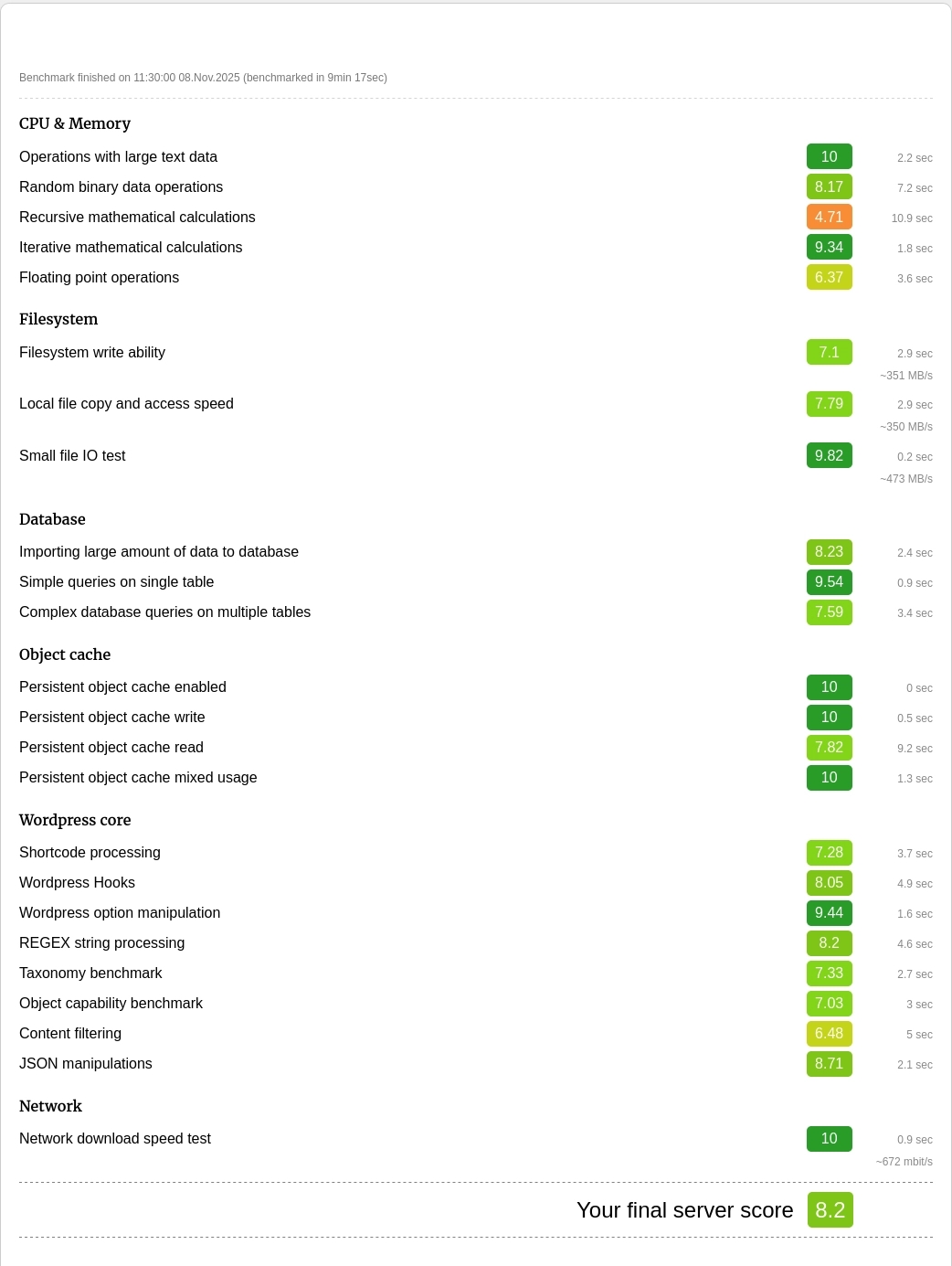
Currently, I’m testing a single web hosting plan, the one I use: the Hosterra shared hosting. To get a clear overview of the actual performance, I tested the plan with the Hosting Benchmark Tools. As with the other benchmarks conducted, the tested WordPress instance is fresh new, with the same theme and plugins, and is the only site on its hosting.
The promise: an efficient and eco-responsible hosting service that is both high-performing and environmentally friendly. Let’s take a look.
WordPress hosting evaluation approach and methodology
Objective
This publication isn’t just another copy of the infinite lists of features displayed on hosting companies’ sales pages; rather, it focuses on what counts as good WordPress hosting: performance, efficiency, and robustness.
Measurement units
Let’s be honest: regardless of the hosting provider, it’s always a battle of big numbers. When comparing plans, we juggle between bytes, octets, and bits. In this post, I convert the values into bytes to avoid confusion.
Renewal
The rates shown reflect the annual cost for standard renewal, without taking into account one-off promotions or entry discounts. The aim here is to assess the real cost of hosting over the medium and long term, after the first year. By opting for a multi-year commitment (2, 3, or more years), some hosts plan reduced monthly rates, which can lower the overall cost over time. In this article, the annual price (incl. VAT) corresponds to renewal once a year.
Advertised consumption / energy efficiency
Web hosting companies are increasingly promoting their green credentials. Between promises of carbon offsetting, “green” data centers, labels, and so on, it’s easy to fall into the trap of greenwashing. Advertisements often focus on carbon footprints, the use of renewable energy, or infrastructure optimization, but rarely on the real day-to-day impact of web hosting. Correlating the performance measured on a WordPress instance with its water and electricity consumption (which should not be produced by fossil fuels) seems to me a solid approach.
About advertised consumption
When hosting is shared, resources are shared between multiple instances. The consumption indicated corresponds to that of the entire server, whether it is used alone or shared with other accounts. It is up to Hosterra to manage the number of accounts per server to optimize resource utilization while maintaining good performance.
WordPress instance tested
A WordPress website on a web hosting package.
- Active installed theme: GeneratePress.
- Active plugins: Hosting Benchmark tool & SQLite Object Cache
- Object caches tested: APCu.
- PHP : 8.3
Glossary
A basic glossary of web hosting vocabulary.
Consult the glossary
- RAM: Random Access Memory, used to temporarily store data utilized by applications for rapid access.
- CPU: Central processing unit, the server’s brain, which executes instructions and processes data.
- vCPU: Virtual CPU, a part of a physical processor allocated to a virtual machine to simulate a dedicated processor.
- NVMe: High-performance storage protocol for SSDs, optimized to reduce latency and increase throughput.
- IO: Input/Output, measuring the server’s ability to read/write data to disk or network.
- Bandwidth: The maximum volume of data that can be transferred between the server and users over a given period, often expressed in Gbit/s or MB/s.
- Shared hosting: A solution where multiple sites share the resources of a single server.
- VPS hosting: A Virtual Private Server that provide dedicated resources (CPU, RAM, storage) on a shared physical server.
Tested hosting plan
Hosterra One
Hosting plan information
- Hosting type: Shared hosting
- Annual renewal price (included one free month) : €75.9 excluding VAT | €91.08 including VAT
- Announced annual consumption: ⚡️ Electricity < 200 kWh/year, 🫧 Water < 6.5 L/year
Advertised resources
| CPU | RAM | Storage | Read/write | Bandwidth |
|---|---|---|---|---|
| 8 vCPU | 32 GB RAM | 10 GB on NVMe | I/O 256 MB/s | 125 MB/s |
Measured performance
| Type | Function | Score /10 | Time / Speed |
|---|---|---|---|
| CPU & Memory | Operations with large text data | 10 | 2.2 sec |
| Random binary data operations | 8.17 | 7.2 sec | |
| Recursive mathematical calculations | 4.71 | 10.9 sec | |
| Iterative mathematical calculations | 9.34 | 1.8 sec | |
| Floating point operations | 6.37 | 3.6 sec | |
| Filesystem | Filesystem write ability | 7.1 | 2.9 sec ~351 MB/s |
| Local file copy and access speed | 7.79 | 2.9 sec ~350 MB/s | |
| Small file IO test | 9.82 | 0.2 sec ~473 MB/s | |
| Database | Importing large amount of data to database | 8.23 | 2.4 sec |
| Simple queries on single table | 9.54 | 0.9 sec | |
| Complex database queries on multiple tables | 7.59 | 3.4 sec | |
| Object cache | Persistent object cache enabled | 10 | 0 sec |
| Persistent object cache write | 10 | 0.5 sec | |
| Persistent object cache read | 7.82 | 9.2 sec | |
| Persistent object cache mixed usage | 10 | 1.3 sec | |
| WordPress core | Shortcode processing | 7.28 | 3.7 sec |
| WordPress Hooks | 8.05 | 4.9 sec | |
| WordPress option manipulation | 9.44 | 1.6 sec | |
| REGEX string processing | 8.2 | 4.6 sec | |
| Taxonomy benchmark | 7.33 | 2.7 sec | |
| Object capability benchmark | 7.03 | 3 sec | |
| Content filtering | 6.48 | 5 sec | |
| JSON manipulations | 8.71 | 2.1 sec | |
| Network | Network download speed test | 10 | 0.9 sec ~84 MB/s |
| Your server score | 8.2 | ||
Summary
| Plan | Hosting type | Annual rate incl. VAT | Annual consumption | Best Score/10 |
|---|---|---|---|---|
| Hosterra One | Mutualisé | 91,08€ INCL. VAT | ⚡️< 200 kWh/an 🫧< 6.5 l/an | 8.2 |


Leave a Reply